Louisiana Laws, Rules and Regulations The regulation of the insurance industry rest primarily with each state. For example, in Louisiana, the agency that governs this responsibility is called the Department of Insurance also known as the DOI. The DOI is responsible for licensing of producers and all persons involved in the business of insurance […]
Ethics For Insurance Professionals: Module 2
October 19, 2012 by
How is the Industry Regulated – The Commissioner of Insurance is entrusted with powers from all branches of Government. Executive: The power to conduct examinations and investigations and to act as a law enforcement officer. The Commissioner also administers the Department of Insurance. Legislative: The power to draft and disseminate rules and regulations that are […]
Ethics For Insurance Professionals: Module 3
October 23, 2012 by
Controlled Business – business written on producer, family members, employer or employees. The Department of Insurance may not grant, renew or continue any license if they find that the license will primarily be used for the purpose of writing controlled business. Controlled business can only represent up to twenty five (25) percent of the commissions […]
Ethics For Insurance Professionals: Module 4
October 23, 2012 by
Unfair Trade Practice–the following Unfair Trade Practice laws contain more information affecting practices that at this time prohibited in the state of Louisiana. Misrepresentations and False Advertising of Insurance Policies Issuing, circulating, or causing to be made any illustration, statement, circular, sales representation, statement or comparison that does any of the following: Misrepresenting the benefits […]
Ethics For Insurance Professionals: Module 5
October 23, 2012 by
Unfair Claim Settlement Practices – It is illegal to commit any of the following acts with a frequency to indicate it as a general business practice. Misrepresenting pertinent facts or insurance policy provisions relating to coverage at issuance Failing to acknowledge and act immediately upon communications with respect to claims arising under insurance polices Failing to implement […]
Ethics For Insurance Professionals: Module 6
October 23, 2012 by
The Insurance Fraud Division –branch of the Department of Insurance that investigates complaints of fraud or fraudulent insurance acts. It conducts background checks on persons applying for licenses and Certificate of Authority. The division has the authority to investigate the affairs of any person who is believed to have violated the Insurance Code. The division may […]
Ethics For Insurance Professionals: Module 7
October 23, 2012 by
Consumer Financial Information Federal law designates the DOI as the agency to set up procedures and establish rules to protect the consumer financial information with respect to insurance sales. The DOI’s regulations requires all of licenses: That consumer must be given notice about the privacy practices and the policies. They describe when information may be released. They provide methods […]
Interpreting a Flood Insurance Policy: Unit 1
November 12, 2012 by
What is a Flood / Flood Exposure Flood (definition used by the National Flood Insurance Program) A general and temporary condition of partial or complete inundation of two or more acres of normally dry land area or of two or more properties (at least one of which is your property). Flood Exposure Floods can […]
Interpreting a Flood Insurance Policy: Unit 2
November 12, 2012 by
Six Common Types of Floods Riverine Floods Occur when rivers, streams and other watercourses rise and overflow their banks. Floods can result from either heavy rainfall or snow melt upstream in their drainage basins. Tidal Floods Arise from high tides, frequently driven by high winds offshore, and from tropical storms making landfall or passing […]
Interpreting a Flood Insurance Policy: Unit 3
November 12, 2012 by
Two Types of Flood Insurance Coverage Building Property The NFIP’s Dwelling Form offers coverage for Building Property up to $250,000 Personal Property The NFIP’s Dwelling Form offers coverage for Personal Property (contents), up to $100,000. [mtouchquiz 11]
Interpreting a Flood Insurance Policy: Unit 4
November 12, 2012 by
National Flood Insurance Program and Other Flood Coverage NFIP Homeowners and dwelling policies exclude damage caused by flood, surface water, wave, tidal water, and overflow of a body of water. Flood coverage is available through policies issued by the National Flood Insurance Program, which is part of the Federal Insurance Administration. The federal government shares […]
Interpreting a Flood Insurance Policy: Unit 5
November 12, 2012 by
Three Important Facts about a Flood Policy Important Facts A Standard Flood Insurance Policy is a single-peril (flood) policy that pays for direct physical damage to property up to the replacement cost or Actual Cash Value (ACV) of the actual damages or the policy limit of liability, whichever is less. Contents coverage must be […]
Interpreting a Flood Insurance Policy: Unit 6
November 12, 2012 by
Choosing Deductibles Choice of deductible is important Choosing the amount of the deductibles is an important decision for the insured. As with car or homeowners insurance, choosing a higher deductible will lower the premium that is paid, but will also reduce the claim payment.The insured can normally choose different deductibles for Building Property and Personal […]
Interpreting a Flood Insurance Policy: Unit 7
November 12, 2012 by
What is Covered and What is Not Covered General Guidance on Flood Insurance Coverage Limitations in areas below the lowest elevated floor and basements Flood insurance coverage is limited in areas below the lowest elevated floor (including crawlspaces) depending on the flood zone and date of construction and in basements regardless of zone, or […]
Interpreting a Flood Insurance Policy: Unit 8
November 12, 2012 by
General Guidance on Flood Insurance Coverage General Guidance on Flood Insurance Coverage Limitations in areas below the lowest elevated floor and basements Flood insurance coverage is limited in areas below the lowest elevated floor (including crawlspaces) depending on the flood zone and date of construction and in basements regardless of zone, or date of construction. […]
Interpreting a Flood Insurance Policy: Unit 9
November 12, 2012 by
How Flood Damages Are Valued The value of flood damage in the Dwelling Form is based on either Replacement Cost Value (RCV) or Actual Cash Value (ACV). Replacement Cost Value (RCV) Replacement Cost Value (RCV) is the cost to replace that part of a building that is damaged (without depreciation). To be eligible, three conditions […]
Interpreting a Flood Insurance Policy: Unit 10
November 12, 2012 by
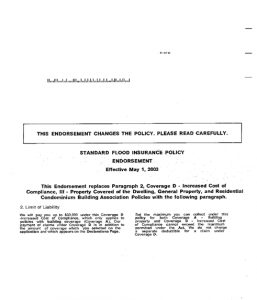
Example Of A Typical Flood Policy Please review the content of this example flood policy to learn what is typically contained. Flood Policy Flood Policy IMPORTANT INFORMATION ABOUT THE NATIONAL FLOOD INSURANCE PROGRAM Federal law requires insurance companies that participate in the National Flood Insurance Program to provide you with the enclosed Summary of Coverage. […]
Casualty Insurance: Unit 1
December 8, 2012 by
Liability Basics Overview The significance of liability exposure rests on the possible severity of a loss. The extent of the loss to a person’s own property is normally limited by the value of the property. In liability exposures, the amount of loss is virtually limitless. The size of a judgment may not only cause […]
Casualty Insurance: Unit 2
December 10, 2012 by
Homeowners Overview This chapter will examine the Homeowners Policy, which provides the same coverage as the stand-alone Comprehensive Personal Liability Policy. Section II is the same in all Homeowners Forms. Protection is provided for legal claims against the insured or family members from occurrences in and around the premises, personal activities, and pets, both on […]
Casualty Insurance: Unit 3
December 10, 2012 by
Personal Automobile Policy Overview The personal automobile Policy (PAP) is a personal lines policy that covers damages resulting from the noncommercial use of an automobile. It is designed to cover an individual’s or family’s personal use of an automobile, and is comprised of six major parts, each of which are discussed in this chapter. Glossary […]