Example Of A Typical Flood Policy
Please review the content of this example flood policy to learn what is typically contained.
Flood Policy |
|
Flood Policy |
IMPORTANT INFORMATION ABOUT THE NATIONAL FLOOD INSURANCE PROGRAMFederal law requires insurance companies that participate in the National Flood Insurance Program to provide you with the enclosed Summary of Coverage. It’s important to understand that the Summary of Coverage provides only a general overview of the coverage afforded under your policy. You will need to review your flood insurance policy, Declarations Page and any applicable endorsements for a complete description of your coverage. The enclosed Declarations Page indicates the coverage you purchased, your policy limits, and the amount of your deductible.You will soon receive additional information about the National Flood Insurance Program. This information will include a Claims Handbook, a history of flood losses that have occurred on your property, as contained in FEMAs data base, and an acknowledgement letter.If you have any questions about your flood insurance policy, please contact your agent.STANDARD POLICYP.O. Box123 Baton Rouge,La.00000NEW POLICY DECLARATIONSPOLICY NUMBER: 123456789 PAYER: INSUREDNamed Insured and Mailing Address: Agent Name an Address:Jack and Jill Insured OURCO1234 Up TheHill Road 4567 AnywhereBaton Rouge,La.00000 B.R.La. 00000 |
| Flood Policy (continued) | FIRST MORTGAGEE / LENDER NAME:
LOAN NUMBER: 012345SECOND MORTGAGEE/LENDER NAME: OTHER MORTGAGEE / LENDER NAME:PROPERTY DESCRIPTIONBUILDING: One floor with no basementCONTENTSHOUSEHOLD CONTENTS LOCATEDA single family residence on first floor onlyNon Elevated buildingRating InformationPROGRAM: Regular COMMUNITY NAME:East Baton RougeParishFIRE ZONE: AECOMMUNITY NUMBER: 220058YEAR BUILT SUBSTANTIALLY IMPROVED: After 11/19/88COMM. RATING DISCOUNT: 15%ELEVATION DIFFERENCE: +04
|
| Flood Policy (continued) | AMOUNTS OF INSURANCE
Basic CoverageBuilding: $50,000 X 00.24 = $120.00Additional Coverage $127,000 X 00.08 = $102.00Contents: $20,000 X 0038 = 76.00SUBTOTAL: $298.00
TotalBuildingCoverage: $177,000Building Deductible: $500Contents Deductible: $500
Community Discount $46.00Probation Surcharge: $ 0.00Total Contents Coverage: $20,000Increased Cost of Compliance Premium: $ 6.00Total Written Premium: $258.00Federal Policy Service Fee: $ 30.00TOTAL PREMIUM PAID: $ 288.00PLEASE REFER TO THE DWELLING POLICY FORM FOR A FULL EXPLANATION OF COVERAGES. |
| Flood Policy (continued) | Important NoticePrivacy PolicyAt OURCO we value you as a customer and share your concerns about privacy. To help you understand how we treat the nonpublic personal information (“customer information”) that we obtain from you or other sources in the course of providing you with products and services. This notice describes our use and protection of that information.Whether you’re doing business with us through your local agent or broker, or ourCustomerInformationCenter, we want you to know that we respect your privacy and we protect your information.
• We do not sell customer information. • We do not share your customer information with persons, companies, or organizations outside that would use that information to contact you about their own products and services. • We expect persons or organizations that provide services on our behalf to keep customer information confidential and to use it only to provide the services we’ve asked them to perform. • Within we communicate to our employees regarding the need to protect customer information, and we’ve established physical, electronic, and procedural safeguards to protect customer information. Below we’ve provided answers to questions that might be on your mind regarding privacy, you may be wondering….. What do we do with your customer information? |
| Flood Policy (continued) | OURCO does not sell your customer information, or medical information, to anyone. Nor do we share it with companies or organizations outside OURCO that would use that information to contact you about their own products and services. If that practice were ever to change, we would, of course, offer you the ability to opt out of this type of information sharing, and we would offer you the opt-out with time for you to respond before the change in our practice took place. |
| Flood Policy (continued) | Your agent or broker may use customer information to help you with your overall insurance program. We may also communicate with you about products, features, and options you have expressed an interest in or that we believe may be of interest to you. We may, without authorization but only as permitted or required by law, provide customer information to persons or organizations both inside and outside of OURCO to fulfill a transaction you have requested, service your policy, market our products to you, investigate or handle claims, detect or prevent fraud, participate in insurance support organizations, or comply with lawful requests from regulatory and law enforcement authorities. These persons or organizations may include: our affiliated companies, companies that perform marketing services on our behalf, other financial institutions with which we have a joint marketing agreement for the sale of our own products, and your agent or broker. |
| Flood Policy (continued) | What kind of customer information do we have, and where did we get it?Much of the customer information that we have about you comes directly from you. When submitting your application or request for insurance or other products and services we offer, or requesting an insurance quote, you may give us information such as your name, address, and Social Security number. We keep information about your transactions with our affiliates, others or us for example, the types of products and services you purchase from us, premiums, account balances, and payment history.We also may collect information from outside sources, including consumer reporting agencies and health care providers. This information may include loss information reports, motor vehicle reports, credit reports, and medical information.
How do we protect your customer information? When we share customer information with companies working on OURCOs behalf, we expect those companies to use that information only to provide the service we have asked them to perform. With OURCO, your customer information is available to those individuals who may need to use it to fulfill and service the Needs of customers. We communicate the need to protect customer information to all employees and agents, especially those individuals who have access to it. Plus, we’ve established physical, electronic, and procedural safeguards to protect customer information. Finally, should your relationship with OURCO end, your customer information will remain protected in accordance with our privacy practices as outlined in this Important Notice.
How can you find out what information we have about you? You may request to either see, or obtain from us by mail, the customer information about you in our records. If you believe that information is incomplete or inaccurate, you may request that we make any necessary corrections, additions or deletions to the disputed customer information. To fulfill your request, we may make arrangements with an insurance support organization or a consumer reporting agency to copy and disclose customer information to you on our behalf. You may also request a more complete description of the entities to which we disclose customer information, or the circumstances that might warrant such disclosures. Please send any of the requests listed above in writing to: OURCO Insurance Company, Customer Privacy Inquiries P.O. Box 12345Baton Rouge,La.00000 |
| Flood Policy (continued) | If you are an Internet user…Our website, OURCO.com provides information about our products and the agencies and brokers that represent us. You may also perform certain transactions on the website. When accessing please be sure to read the Privacy Statement that appears there.To learn more, the OURCO.com Privacy Statement provides important information relating to your use of the website, including, for example, information regarding: 1) our use of online collecting devices known as “cookies”; 2) our collection of information such as IP address (the number assigned to your computer when you use the Internet), browser and platform types, domain names, access times, referral data, and your activity while using our site; 3) who should use our web site; 4) the security of information over the Internet. And 5) links and co-branded sites.
We hope you have found this Important Notice helpful. If you have any questions or would like more Information, please don’t hesitate to contact your agent or call the OURCO Customer Hotline at 1-225-123-4567
This notice is being provided on behalf of the following companies: OURCO Management Services OURCO Insurance Company Insurance Services of OURCO
|
| Flood Policy (continued) | FEMA: NATIONAL FLOOD INSURANCE PROGRAM SUMMARY Of COVERAGEThis document was prepared by the National Flood Insurance Program (NFIP) to help you understand your flood insurance policy. It provides general information about deductibles, what is and is not covered by flood insurance, and how items are valued at time of loss.This document is based on the standard Flood Insurance Policy Dwelling Form, which is used to insure one to four family residential buildings and single family dwelling units in a condominium building. There are two other policy forms:
|
| Flood Policy(continued) | What is a Flood?Flood insurance covers direct physical loss caused by “flood.” In simple terms, a flood is an excess of water on land that is normally dry. Here’s the official definition used by the National Flood Insurance Program.A flood is “A general and temporary condition of partial or complete inundation of two or more acres of normally dry land area or of two or more properties (at least one of which is your property) from:• Overflow of inland or tidal waters;
• Unusual and rapid accumulation or runoff of surface waters from any source; • Mudflow; or • Collapse or subsidence of land along the shore of a lake or similar body of water as a result of erosion or undermining caused by waves or currents of water exceeding anticipated cyclical levels that result in a flood as defined above. *Mudflow is defined as “A river of liquid and flowing mud on the surfaces of normally dry land areas, as when earth is carried by a current of water…”
|
Flood Policy(continued) |
Three Important Facts About Your Flood PolicyA Standard Flood Insurance Policy is a single-peril (flood) policy that pays for direct physical damage to your insured property up to the replacement cost or Actual. Cash Value (ACV) (See “How Flood Damages Are Valued”) of the actual damages or the policy limit of liability, whichever is less.1. Contents coverage must be purchased separately.2. It is not a valued policy. A valued policy pays the limit of liability in the event of a total loss.
For example: Your home is totally destroyed by a fire and it costs $150,000 to rebuild. If your homeowners insurance policy is a valued policy with a $200,000 limit of liability on the building, you would receive $200,000. Flood insurance pays just the replacement cost or ACV of actual damages, up to the policy limit. 3. It is not a guaranteed replacement cost policy. A guaranteed replacement cost policy pays the cost to rebuild your home regardless of the limit of liability. For Example: Your home is totally destroyed by a fire and it cost $200,000 to rebuild. If your homeowners insurance policy is a guaranteed replacement cost policy with a $150,000 limit of liability on the building, you would receive $200,000. Flood insurance does not pay more than the policy limit. |
Flood Policy(continued) |
Choosing DeductiblesChoosing the amount of your deductibles is an important decision. As with car or homeowners insurance, choosing a higher deductible will lower the premium you pay, but will also reduce your claim payment.You can normally choose different deductibles for Building Property and Personal Property coverage. The deductibles will apply separately to Building Property and Personal Property claims. Your Mortgage Company can require that your deductible is no more than a certain amount.Review the Declarations Page in your flood insurance policy for amounts of coverage and deductibles. Talk with your insurance agent, company representative, or lender about raising or lowering deductibles.
Reminder: Keep Your Receipts While you are not expected to keep receipts for every household item and article of clothing, do try to keep receipts for electronic equipment, wall-to-wall carpeting, major appliances, and other higher cost items. Your adjuster will be able to process your claim more quickly when you can prove how much items cost at the time of purchase. What is Covered by Flood Insurance — and What’s Not Generally, physical damage to your building or personal property “directly” caused by a flood is covered by your flood insurance policy. For example, damages caused by a sewer backup are covered if the backup is a direct result of flooding. However, if the backup is caused by some other problem, the damages are not covered. The following charts provide general guidance on items covered and not covered by flood insurance. Refer to your policy for the complete list. What is not insured by either Building Property or Personal Property Coverage?
|
| Flood Policy(continued) | General Guidance on Flood Insurance Coverage limitations in Areas Below the Lowest Elevated Floor and BasementsFlood Insurance coverage is limited in areas below the lowest elevated floor (including crawlspaces) depending on the flood zone and date of construction (refer to Part III, Section A.8 in your policy) and in basements regardless of zone, or date of construction. As illustrated below these areas include1. Basements 2. Crawlspaces under an elevated building 3. Enclosed areas beneath buildings elevated on full story foundation walls that are sometimes referred to as “walkout basements” and 4. Enclosed areas under other types of elevated buildings.What is insured under Building Property Coverage
What is insured under Personal Property Coverage
What is not insured by either Building Property or Personal Property Coverage
|
| Flood Policy(continued) |
How Flood Damages Are Valued The value of flood damage in the Dwelling Form is based on either Replacement Cost Value (RCV) or Actual Cash Value (ACV).Replacement Cost Value (RCV)Replacement Cost Value (RCV) is the cost to replace that part of a building that is damaged (without depreciation). To be eligible, three conditions must be met:1. The building must be a single-family dwelling, and2. Be your principal residence, meaning you live there at least 80 percent of the year, and3. Your building coverage is at least 80 percent of the full replacement cost of the building, or is the maximum available for the property under the NFIP.Actual Cash Value (ACV) Actual Cash Value (ACV) is Replacement Cost value at the time of loss, less the value of its physical depreciation. Some building items such as carpeting are always adjusted on an ACV basis. For example: Wall-to-Wall carpeting would lose between 10% -14% of its value each year, depending on the quality of the carpeting. This depreciation would be factored in the adjustment. Personal property is always valued at ACV. |
Flood Policy(continued) |
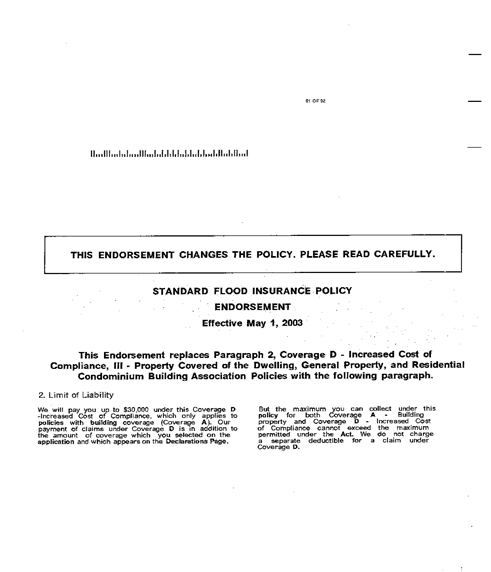
Special Considerations for Multiple ClaimsProperty owners of “severe repetitive loss properties” may be eligible for a FEMA mitigation grant for property improvements that reduce the likelihood of future flood damages. Property owners who refuse the grant money could be required to pay increased flood insurance premiums.A property is defined as a “severe repetitive loss property” when it meets one of these conditions:1. Four or more separate flood claim payments have been made and each claim payment exceeds $5,000.2. At least two flood claim payments have been made and the cumulative payments exceed the value of the property.WHAT IS INCREASED COST OF COMPLIANCE (ICC) COVERAGE?Most NFIP policies include ICC coverage, which applies when flood damages are severe. ICC coverage provides up to $30,000 of the cost to elevate, demolish, or relocate your home. If your community declares your home “substantially damaged” or “repetitively damaged” by a flood, it will require you to bring your home up to current community standards.The total amount of your building claim and ICC claim cannot exceed the maximum limit for Building Property coverage ($250,000 for a single-family home). Having an ICC claim does not affect a Personal Property claim (up to $100,000), which is paid separately.Details about eligibility are in Part III, Section D of your policy. |
| Flood Policy(continued) |
A final noteThis document provides general information about flood insurance coverage. However, please be aware that your Standard Flood Insurance Policy, your application, and any endorsements, including the Declarations Page, make up your official contract of insurance. Any differences between this information and your policy will be resolved in favor of your policy. If you have questions, call your insurance agent or company representative.FEMACongress created the National Flood Insurance Program (NFIP) in 1968 to reduce future flood damage through floodplain management, and to provide people with flood insurance through individual agents and insurance companies. The Federal Emergency Management Agency (FEMA) manages the NFIP. As required by Congress, this document was prepared by the NFIP to help flood insurance policyholders understand their policy. |
[mtouchquiz 18]